
Estimated Reading Time: 10 minutes
Update on 20/05/2026: Today, the long-form novel Taiwan Travelogue by Taiwanese writer Yang Shuang-zi made history by winning the International Booker Prize. During her acceptance speech, she stated: “There are those who think that art and literature should remain detached from politics. However, I believe that literature can never be separated from the soil that nurtures it. In that regard, literature has inherently never been uncoupled from politics.”
This article was conceived against the backdrop of a major political recall movement in Taiwan (1 Feb – 23 Aug, 2025). It was a time when many artists weaponised their works, songs, and essays to assert their stances, hoping to exert some modicum of social influence.
Naturally, this provoked an antithetical response from both the public and fellow creators alike. For this opposing faction, dragging art into the political mire was seen as a form of ideological madness—a direct defilement of artistic purity.
Amidst this whirl of chaos, there came a day when I came across a video of a high school student performing an original song at school. Though the finer details escape me, I distinctly remember the core lyric expressing the sentiment that art “should not” be entangled with politics.
I found this notion somewhat absurd. Since antiquity, the relationship between art and politics has been fundamentally inseparable. I wonder if he realised that the very moment he sang the words “Keep art as art, and politics as politics,” his work had already partaken in a political discourse.
You cannot tell me that an artist who depicts scenes of raw, passionate queer sex does so without a political stance. If they view such a depiction as a sublime celebration of love and the human body, their perspective leans liberal; conversely, if it is intended to satirise a specific demographic, their stance likely aligns with conservatism.
Whether in the creation or the interpretation of a work, an artist’s core beliefs are always embedded within it, projected outward in the exact manner they wish the public to perceive them. These convictions are distilled from a lifetime of knowledge, experience, and thought. They naturally carry value preferences and ideologies, and by extension, they are inevitably bound to the political.
In fact, history’s most brilliant artists have always been inextricably linked with politics. I would even go so far as to argue that an artist who claims to have “no political inclinations whatsoever” simply does not yet understand their own beliefs, nor do they know what it is they truly wish to communicate.
Beethoven’s Eroica and the French Revolution
Beethoven, as one of the first musicians to break free from the shackles of court patronage, championed freedom, democracy, and anti-oppression, fiercely opposing aristocratic control over art. If the public of his time had told him, “You mustn’t let art be tainted by politics,” would we ever have received his Symphony No. 3 (Eroica)—a masterpiece born from his support for the French Revolution and the rise of Napoleon Bonaparte?
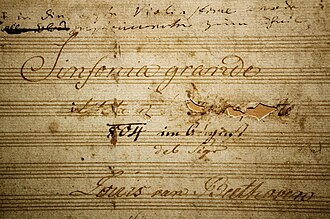
When Napoleon later declared himself Emperor, Beethoven felt deeply betrayed and furiously scratched through the original dedication on the score’s title page with such force that he tore the paper (as shown in the featured image). This alone demonstrates that as political convictions shift, art itself changes in tandem.
Wagner’s Der Ring des Nibelungen and Social Satire
Richard Wagner’s staggering magnum opus, Der Ring des Nibelungen (The Ring of the Nibelung), is steeped in nationalist imagery, utilising heavy symbolism to deliver sharp social critiques. His indictments of the corruption of class power (the ring), the exploitation of capitalism (the dwarf miners), and the collapse of the political order (Götterdämmerung) are laid bare through the narrative. Not a single word mentions politics, yet politics permeates every note.
And yet, this towering musical genius was a man of severe anti-Semitic prejudice. His glorification of the Germanic race and his notorious anti-Semitic essay, Das Judenthum in der Musik (Jewishness in Music), would go on to exert a profound and devastating influence on Adolf Hitler.
People love to joke that if only that fine arts academy had accepted Hitler, the horrors of the subsequent decades might have been averted. However, according to Hitler’s childhood friend August Kubizek and several close associates, politics was always his true calling; art was merely the vessel through which he channeled his political ideology.
Wagner’s Rienzi and the Awakening of Hitler’s Political Fanaticism
Hitler was a fanatical devotee of Wagner, viewing him as “the pure embodiment of the German soul and art.” The genesis of this obsession trace back to a 16-year-old Hitler watching Wagner’s early opera, Rienzi, in Linz. The story of a low-born hero who uses nothing but eloquence and iron will to become the “Tribune” and restore Rome’s glory triggered a fierce psychological projection in the frustrated young outcast.
After the performance, he dragged Kubizek up the freezing slopes of the Freinberg at midnight. Standing on the summit in a trance-like, near-religious ecstasy, Hitler delivered a fervent, roaring speech about his own divine destiny to save the German nation. It was the absolute awakening of his Messiah complex. In 1939, as Führer, he reflected on that night with Kubizek and solemnly remarked: “In jener Stunde begann es” (“In that hour, it began”).
The Ride of the Valkyries and the Militant Atmosphere
The Nazi propaganda machine and cultural ministries routinely cited Wagner’s anti-Semitic writings to justify their claims that Jews were “destroying German culture,” while simultaneously weaponising his prestige to suppress and demean Jewish composers like Giacomo Meyerbeer and Felix Mendelssohn. By this point, Wagner’s music had been completely subsumed by political orchestration.
But would the man himself have objected? Judging by what we know—his deep-seated anti-Semitism combined with the militant, blood-pumping atmosphere of Walkürenritt (The Ride of the Valkyries)—we can reasonably surmise that he might have actively welcomed it.
Shostakovich’s Symphony No. 5 and the Stalinist Regime
In stark, tragic contrast stands the ill-fated Dmitri Shostakovich. Composing under the suffocating terror of Stalin’s Soviet regime, he utterly loathed creating works that served an ideology alien to his own. Consequently, he faced denunciation orchestrated by Stalin himself, pushing him to the precipice of disgrace and political purging.
In response, he composed his Symphony No. 5. Superficially, the work was billed by the state apparatus as “a creative artist’s meaningful response to just criticism,” seemingly glorifying the great Stalinist regime. In reality, it was a coded, biting satire of totalitarianism. When a symphony’s core is to “celebrate a hero,” the fourth movement—the finale—should conventionally burst with triumphant, glorious jubilation (much like Beethoven’s Eroica mentioned earlier).
Instead, the tempo of this fourth movement is agonizingly dragged out; the final notes screech over dissonant chords, and the brass and percussion pile on layer after suffocating layer, inducing an acute sense of dread. The entire movement sounds like “forced glory” rather than spontaneous joy. It is a hollow, anxious, and oppressive compulsion—the twisted grimace of someone forced to smile, a masquerade under duress.
Musicologist Solomon Volkov, reflecting on his private conversations with Shostakovich in Testimony, famously remarked:
“It’s as if someone were beating you with a stick and saying, ‘Your business is rejoicing, your business is rejoicing,’ and you rise, shakily, and go off muttering, ‘Our business is rejoicing, our business is rejoicing.'”
Perfectly encapsulates Shostakovich’s agony of forced compliance under tyrannical duress.
Anthems of Anti-War and Elixirs for an Era
For more overt examples, one need only look to Krzysztof Penderecki’s Threnody for the Victims of Hiroshima (which I can never listen to in full… it’s simply too taxing on the heart 😩 so I’ve come here to inflict it upon you lot) and Benjamin Britten’s War Requiem—both works thick with anti-war sentiment.
To pivot to animation (a bit sudden, I know), masterpieces like Hayao Miyazaki’s Porco Rosso, Nausicaä of the Valley of the Wind, and Princess Mononoke—and, of course, my beloved Attack on Titan by Hajime Isayama—are all thoroughly saturated with profound anti-war, political undercurrents.
Picasso’s Manifesto on Artists and Politics
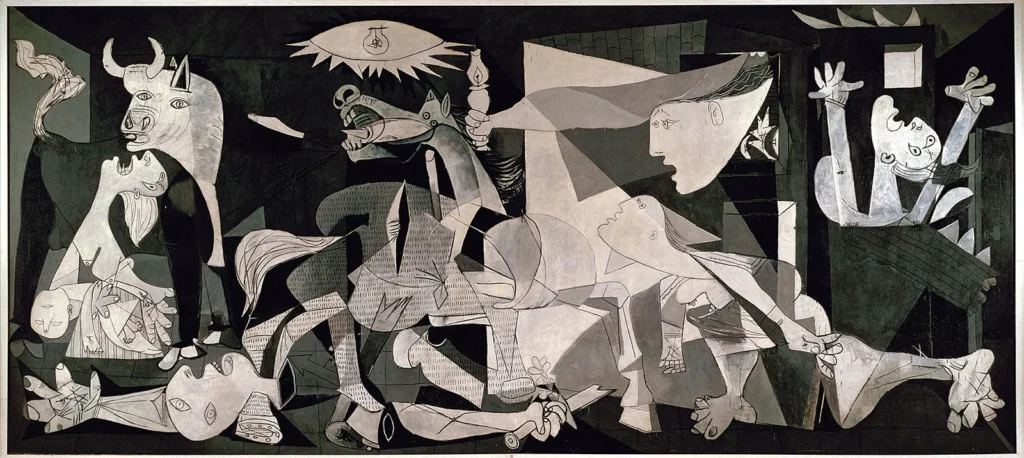
All this is to substantiate my original premise: art and politics cannot be uncoupled. As Pablo Picasso unequivocally asserted:
“What do you think an artist is? An imbecile who has only eyes if he’s a painter, or ears if he’s a musician, or a lyre at every level of his heart if he’s a poet, or even, if he’s a boxer, just his muscles?
On the contrary, he’s at the same time a political being, constantly alive to heartrending, fiery, or happy events, to which he responds in every way. How would it be possible to feel no interest in other people and by virtue of an ivory-tower indifference to detach yourself from the life which they so copiously bring you?
No, painting is not done to decorate apartments. It is an instrument of war, for attack and defense against the enemy.”
Even if an artist feels conflicted or confused about their own stance, it does not alter this reality. The political landscape itself shifts with the turbulence of the times—sometimes clear, sometimes chaotic. And chaos, in itself, is a definitive state.
Political ideology exists on a spectrum; just because an artist or a work does not sit at the extreme ends does not mean they are detached from politics. As long as an artist lives within a society, they are inevitably shaped by something, surrounded by a specific system of values. Ultimately, this will always bleed into the way their work is expressed and interpreted.
To put it another way: “An artist’s political ideology is the imaginary relationship of individuals to their real conditions of existence.”